workonward
Redesigning the Candidate Onboarding Experience
Streamlining onboarding and job discovery to reduce friction and increase candidate activation.
Role
Product Designer
Timeline
3 weeks
Responsibilities
UX Research · Product Strategy · UI Design · Design System
Deliverables
Onboarding Flow · Dashboard · Design System


CHALLENGE
How might we reduce the onboarding friction of new job seekers while strengthening their first impression of the platform and increasing candidate activation?
CONTEXT
WorkOnward is a B2B map-based hiring platform that connects local job seekers with nearby employers. It emphasizes location-first job discovery, helping candidates explore opportunities on an interactive map and enabling businesses to hire talent within their communities.
SCOPE SUMMARY
3 Weeks
Sole Product Designer
Startup
Onboarding Redesign
Dashboard Redesign
Design System Redesign

Design Solution
Design objectives
The redesign focused on three key objectives: reducing onboarding friction, prioritizing job discovery over profile completion, and establishing a scalable design system to support future product growth.
1
2
3
HEURISTICS audit
The sign-up process was short but failed to collect enough essential information upfront, pushing most profile setup into a lengthy dashboard experience for new job seekers.
INSIGHT
A drop-off in the dashboard pages indicates that new job seekers are faced with cognitive overload, unwilling to complete the onboarding, and thus affecting job seeker retention rates on WorkOnward.

USER FLOW
Because WorkOnward serves frontline and local workers who may be searching between shifts, onboarding needs to prioritize speed and clarity: collecting what matters without delaying access to jobs.
01
Create Account.
Quick and simple sign up to get started.

02
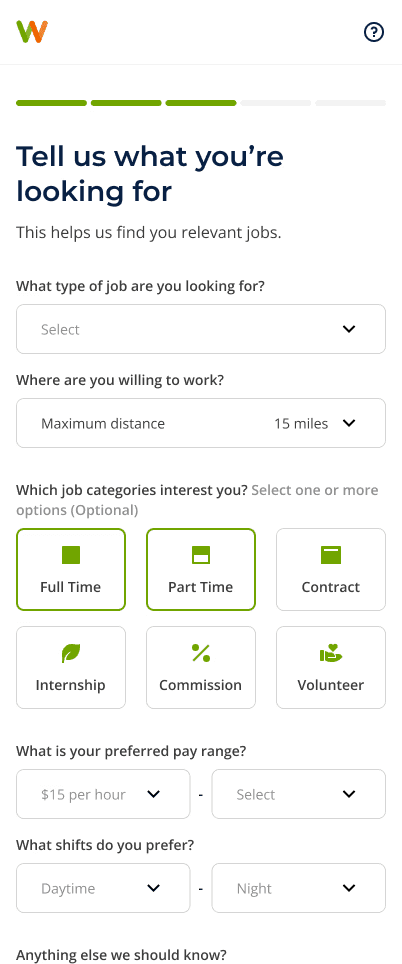
Set Your Basics.
Tell us what you're looking for so we can show you relevant jobs right away.
03
See your first job matches.
Get personalized job recommendations based on your location and preferences.

04
Complete your profile over time.
Add more details when it's convenient. Each section helps us find better matches.


redesign
The onboarding redesign served to give job seekers earlier access to job matching features while progressively building stronger profiles as they stayed on the platform.
testing disclaimer
Job Seeker individuals who tested and reviewed the sign-up process and dashboard redesign were done independently by me through the consent of WorkOnward.
Sign-Up Screen Redesign

Example screens from Re-designed sign-up experience.
1
2
3
4
testing INSIGHT
Tested in contrast to the original arding process, 3 new job seekers reported to understand WorkOnward's value proposition as a local map based hiring platform better, and stated they would be more likely to use it.
Dashboard Screen Redesign

Example screens from Re-designed sign-up experience.
1
2
3
4
testing INSIGHT
Tested in contrast to the original dashboard, 3 new job seekers experienced a 47% overall reduction in time required to complete a comprehensive job seeker profile.
scalable design system
Redesigning the design system was critical to approach the onboarding and dashboard screens with consistency.
Utilizing Claude and Codex, I audited WorkOnward's existing design system, branding, and interfaces and found several design inconsistencies and WCAG accessibility issues. I used Codex to guide me through design system refinements and token library creation, while connecting the library to claude design MCP in order to update future designs.
Google Sheets Database
With the consultation of Codex, I created an in-depth database of all design system specifications including their token names, usages, and more. I created the database as a reference for future designers, developers, and to ease the process of making the figma design system library.

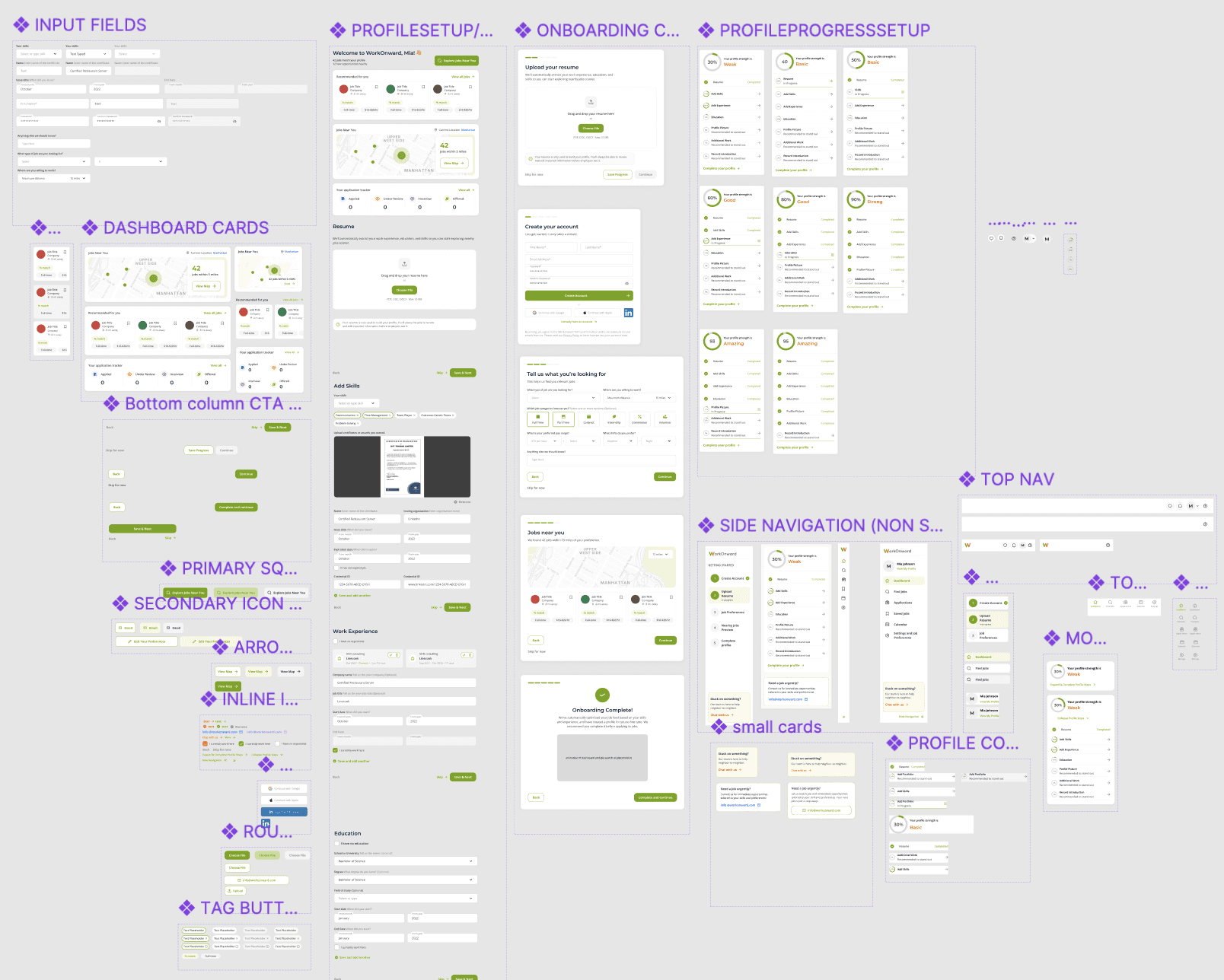
Figma Design System Library
After transferring the design system metadata into figma's variable library, I was able to begin redesigning consistent cards, buttons, and text entry components.

AI development
I translated my Figma designs into functional prototypes, while maintaining control over the design system, interactions, and UX decisions, using Claude Code MCP as an implementation tool.
Accelerating Design to Code
I provided Claude with my Figma prototype and existing design system to translate the redesigned onboarding flow into functional, code-ready screens. I constrained AI-generated changes to minor UI and content refinements, preserving the core UX and visual decisions from my Figma designs.
Scaling an Existing System
Once the job seeker experience was established, I used Claude to accelerate the mobile and employer-side onboarding flow by extending the same components, patterns, and design system. This reduced repetitive design work while maintaining consistency across both user experiences.
Expected Impact
Creating a foundation for a more engaging job search experience.
INSIGHT
The redesign shifted WorkOnward from a profile-first experience toward a progressive journey that delivers value earlier. By restructuring onboarding, simplifying navigation, and introducing profile completion over time, the experience better balances job seekers’ need to quickly find opportunities with WorkOnward’s need for meaningful candidate data.
01
Faster Path to Value
3 tested job seeker users revealed that the newer onboarding process was faster by 47% and more practical as they could discover relevant nearby jobs earlier instead of completing their entire profile first.
02
Lower Perceived Effort
Progressive onboarding, skippable steps, and focused profile tasks broke the lengthy process into manageable interactions.
03
Stronger Matching Foundation
Collecting essential preferences earlier gave WorkOnward more data to personalize job recommendations while allowing profiles to grow over time.
Next steps
Once the redesigned experience is fully implemented, I would evaluate its impact by tracking the following KPI's: Candidate activation, onboarding completion, time to first job recommendation, profile completion, and application conversion. These metrics would help determine whether the new progressive onboarding flow successfully reduces friction while helping job seekers reach relevant opportunities faster. The insights would then inform future iterations and identify where the experience can continue to improve.
Up next
Access Required
This case study is protected due to confidentiality agreements and is intended only for professional viewing.
To request access, please email srishtybhavsar6@gmail.com. I usually respond within the day!